Artificial intelligence is no longer a tool-it's a co-pilot, a strategist, and a competitive moat. But most businesses are still treating AI like a static utility: plug in a model, get answers, and hope for the best. That approach is about to become obsolete.
The future belongs to agentic AI systems-systems that don't just respond but learn, adapt, and compound your organization's unique expertise. The companies that thrive in the AI era won't be the ones with the best models; they'll be the ones with the best learning loops.
This isn't just an upgrade. It's a fundamental architectural shift.
The Problem: Renting AI vs. Owning It
Today, most businesses use AI like a rented apartment:
- You move in (deploy a model).
- You decorate (fine-tune it with your data).
- But when the landlord (the model provider) changes the rules, you're out on the street.
What happens when:
- The model gets updated, and your customizations break?
- The provider restricts access (like the recent US ban on frontier models for non-US nationals)?
- Your competitors are using the same model, eroding your differentiation?
The solution? Stop renting. Start owning.
The Agentic AI Blueprint: 4 Pillars of Sovereignty
1. Build Systems That Improve Over Time
AI shouldn't be a one-time deployment. It should be a living system that gets smarter with every interaction.
How?
- Continuous Learning: Your AI should ingest feedback from every workflow-whether it's a customer service chat, a supply chain decision, or a fraud detection alert.
- Adaptive Workflows: Instead of static rules, your systems should dynamically adjust based on real-world outcomes.
Example: A retail AI that doesn't just set prices but learns from sales data, competitor moves, and even weather patterns to optimize in real time.
Key Question: Is your AI getting better every day, or is it stuck in 2023?
2. Retain Control Over Your IP
The real test of AI sovereignty is this: Can you swap out a "generalist" model (like a global LLM) without losing the "company veteran" expertise embedded in your system?
If the answer is no, you don't own your AI-it owns you.
How to Pass the Test:
- Modular Architecture: Design your AI so that models are plug-and-play. Your institutional knowledge (the "company veteran" layer) should live separately from the base model.
- Private Knowledge Bases: Store your proprietary data, workflows, and insights in a system that outlives any single model.
Example: A manufacturing firm using AI for predictive maintenance should be able to switch from Model A to Model B without losing years of machine-specific insights.
Key Question: If your AI provider disappeared tomorrow, would your business still function?
3. Measure What Matters (Not Just Benchmarks)
Most AI evaluations focus on generic benchmarks (e.g., "How well does it score on this public dataset?"). But real business value comes from private evals-metrics tied to your outcomes.
How to Build Private Evals:
- Outcome-Based Metrics: Instead of accuracy, measure business impact (e.g., "Did this AI reduce customer churn by 10%?").
- Real-World Testing: Use internal data traces (e.g., call center logs, production line sensors) to test AI performance in your environment.
Example: An insurance company shouldn't care if its fraud detection AI scores well on a public dataset-it should care if it catches 20% more local scams.
Key Question: Are you optimizing for vanity metrics or real results?
4. Turn Your Workflows Into Compoundable IP
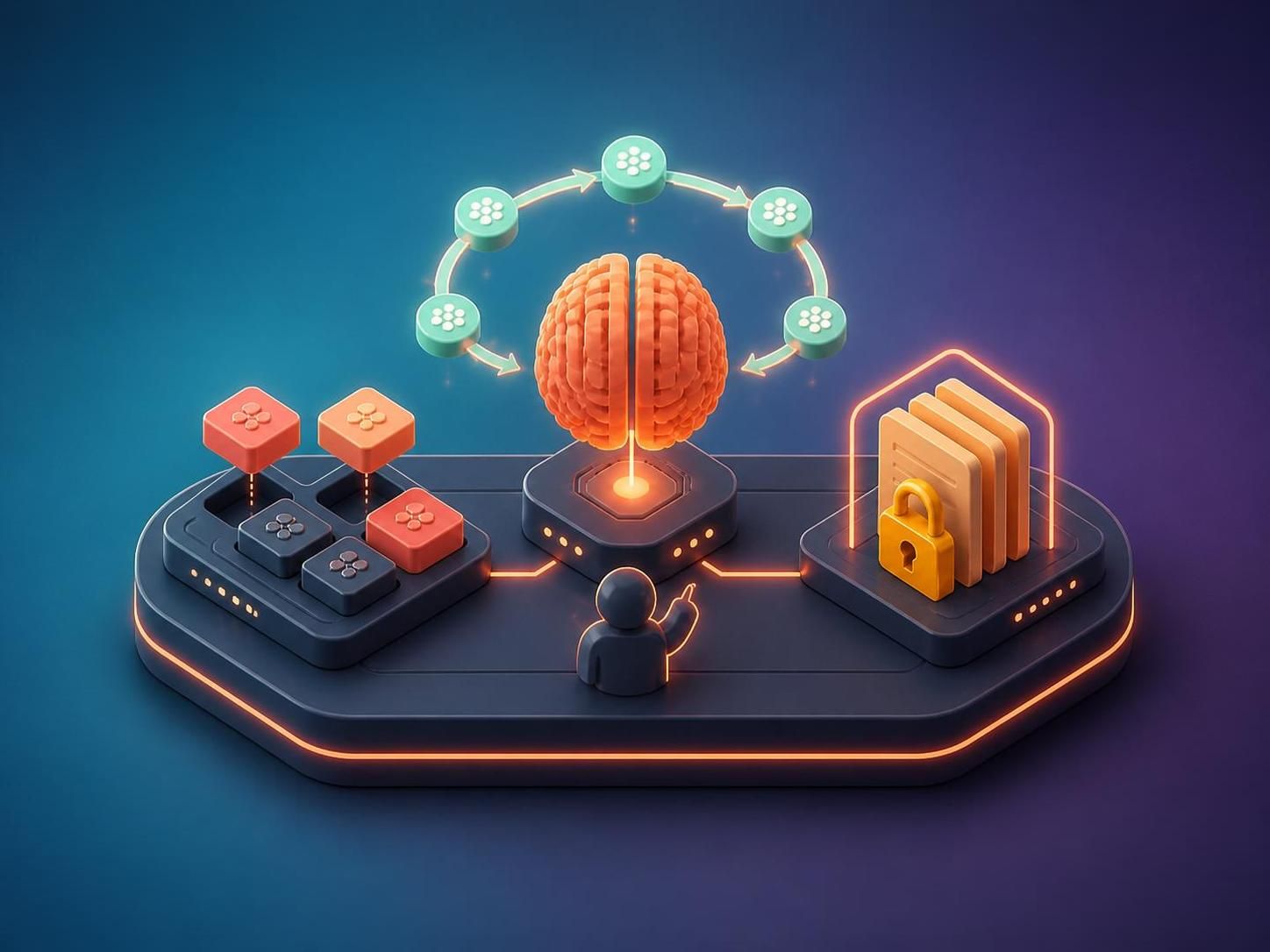
The real magic of agentic AI is that it compounds. Every improvement generates better training data, which leads to even better performance-creating a virtuous cycle of learning.
How to Build the Loop:
- Reinforcement Learning from Real Traces: Let your AI learn from actual business interactions (e.g., sales calls, support tickets, production logs).
- Institutional Memory as a Knowledge Base: Make your tacit knowledge (the stuff only your employees know) queryable and scalable.
Example: A bank's credit risk AI should improve with every loan approved or denied, not just rely on static historical data.
Key Insight: "This loop becomes the new IP of the firm. I think of it as a hill-climbing machine. And unlike most assets, it compounds."
Key Question: Is your AI a cost center or a compounding asset?
The Competitive Advantage: Why Early Builders Win
Companies that master agentic AI early will have an advantage that's hard to replicate, no matter what new models emerge.
Why?
- Network Effects: The more your AI learns, the harder it is for competitors to catch up.
- Defensibility: Your proprietary learning loop becomes a moat-even if a rival gets the same base model, they won't have your institutional knowledge.
- Resilience: You're not dependent on any single provider-you control your own destiny.
Example: Imagine two retail chains:
- Chain A uses a generic AI for dynamic pricing.
- Chain B has an agentic system that learns from its local customer behavior, supply chain quirks, and even staff insights.
When a new model comes out, Chain A has to start over. Chain B just plugs it in and keeps climbing.
Who wins? The one with the learning loop.
How to Get Started: A 3-Step Roadmap
1. Audit Your AI Dependencies
- What models are you currently using?
- Where is your institutional knowledge stored?
- Could you swap a model without losing critical insights?
2. Pilot an Agentic System
Start small:
- HR: Build an AI that learns from internal hiring data (not just generic resume screening).
- Manufacturing: Deploy a predictive maintenance system that improves with every machine cycle.
- Retail: Test a dynamic pricing engine that adapts to local demand patterns.
3. Invest in Sovereignty
- On-Premise or Private Cloud: Ensure your AI runs on infrastructure you control (e.g., Neurux.ai).
- Open Standards: Avoid vendor lock-in by using modular, swappable components.
- Local Talent: Upskill your team in AI fine-tuning, reinforcement learning, and prompt engineering.
The Bottom Line: AI as a Hill-Climbing Machine
The businesses that dominate the next decade won't be the ones with the fanciest models. They'll be the ones with the best learning loops-systems that compound knowledge, retain control, and adapt faster than the competition.
The choice is clear:
- Rent AI and stay at the mercy of providers.
- Own AI and turn it into your unfair advantage.
The question is: Which side of history will your business be on?
Ready to Build Your Learning Loop?
The agentic AI revolution isn't coming-it's already here. While most companies are still renting intelligence from model providers, the builders are laying the foundation for systems that compound expertise with every interaction.
At Neurux, we help enterprises deploy agentic AI systems on their own infrastructure-with full data sovereignty, modular model architectures, and the kind of learning loops that turn AI from a cost center into a compounding asset.
Contact our team to explore how agentic AI can transform your business and start building your learning loop before your competitors do.